Industrial vs. Consumer Cyanoacrylates: What’s the Difference?
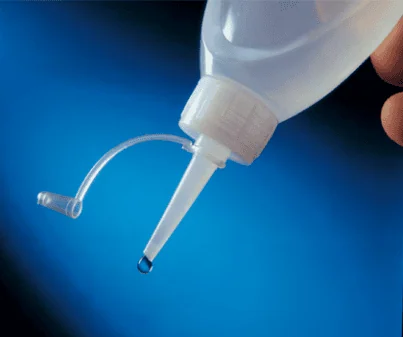
In many manufacturing circles, cyanoacrylates—often known as super glues—suffer from a reputation of being fragile or unreliable. This misconception stems largely from experiences with consumer-grade adhesives found on retail shelves, which are general-purpose adhesives not meant for high-performance industrial applications. However, cyanoacrylate industrial adhesives are some of the most effective and efficient bonding methods for many common assembly applications.
The distinction lies in chemical purity and engineering. Standard cyanoacrylates can exhibit brittle behavior under dynamic stress; however, industrial-grade formulations are available with impact resistance and flexibility tailored for specific applications.
Learn more about how consumer-grade vs. industrial cyanoacrylates compare in terms of chemical purity, technical performance specifications, and total cost of ownership.
Purity and Chemical Composition
Performance of cyanoacrylate adhesives is driven by formulation control, including monomer quality, stabilizer systems, and performance modifiers, not simply overall chemical purity. Consumer-grade cyanoacrylates are typically formulated for general-purpose use, prioritizing ease of use and shelf stability rather than precise performance under controlled industrial conditions.
A high-purity industrial cyanoacrylate formulation consists of a precise, consistent blend of monomers, stabilizers, thickeners, and performance modifiers depending on the intended application. This purity and quality control promote predictable, consistent, and high-strength bonding for the given substrates. Assembly lines use these high-purity, high-strength industrial adhesive formulas to bond even dissimilar materials, including rubber to metal, plastic to plastic, and ceramic to wood.
Technical Specifications: Shear, Tensile, and Impact Strength
Manufacturing environments often subject joined parts to intense physical stress. Unlike consumer-grade cyanoacrylates that may turn brittle and shatter during parts assembly, high-strength industrial adhesives can resist sudden impacts, heavy load capacities, and frequent handling.
Formulators engineer professional-grade cyanoacrylate super glue to maintain distinct shear and tensile strength profiles. This exact formulation prevents catastrophic joint failure during active product use—critical in automotive, electronics, and select aerospace applications where validated
Standardizing Performance with Technical Data Sheets (TDS)
Consumer cyanoacrylates are general-purpose adhesives not intended for precise, repeatable performance at scale. In industrial assembly environments, process engineers require Technical Data Sheets (TDS) for every industrial cyanoacrylate formulation to verify that they will work for their particular application. TDS helps standardize performance, containing the following types of property data:
- Viscosity levels. Documented thickness measurements dictate how the liquid flows within an applicator and into microscopic gaps in the substrates.
- Cure times. Knowing the fixture and full cure times allows operators to calculate accurate assembly line speeds. Fixture times can range from a few seconds to over a minute, depending on bond line thickness, substrate, and formulation. Full cure can take up to 24 hours.
- Temperature thresholds. Laboratory data defines the exact thermal limits the cured bond can withstand before degrading. Typical cyanoacrylate temperature resistance ranges from approximately -65 °F to 180 ºF, depending on the specific formulation.
Shelf-Life and Storage Stability in Industrial Environments
Industrial-grade cyanoacrylates are also designed for optimal long-term storage in industrial environments. Unlike consumer cyanoacrylates, Industrial cyanoacrylates are available in a range of packaging, from small precision applicator bottles to bulk containers designed to suit production environments. With the right storage protocols, industrial cyanoacrylates have predictable shelf lives and can last throughout the intended production cycle.
Upfront vs. Lifetime Cost
Retail glues feature a low initial price but create bonds that frequently lack necessary strength. While consumer adhesives present a lower upfront cost for general household repairs, users must apply excess volume to compensate for their weaker chemical profiles. In contrast, industrial CA glue requires significantly less product to achieve the correct bond strength. This minimal consumption lowers the total cost per unit and the total cost of ownership. Specifying industrial-strength cyanoacrylate glue also reduces costly warranty claims and factory rework.
Why Industrial-Grade Cyanoacrylates Are Vital for Professional Assembly
Industrial cyanoacrylates offer greater chemical purity, bond strength, formula uniformity, and application-specific performance characteristics than consumer-grade cyanoacrylates. These attributes make industrial cyanoacrylates ideal for many industrial assembly and manufacturing processes.
Aron Alpha Industrial Krazy Glue™ manufactures advanced industrial cyanoacrylates for automotive, medical device, electronics, and other assembly applications. In many cases, our industrial cyanoacrylate formulations can reduce or complement traditional fastening methods. We can recommend specific industrial CA glues to optimize your assembly processes.
Contact us or request information to discuss your specific bonding requirements.