FAQs
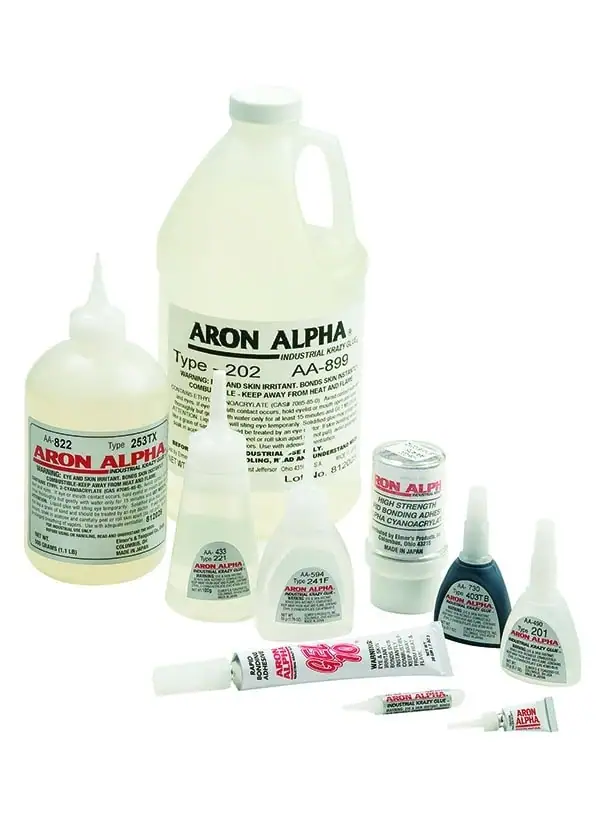
Cyanoacrylates—also known as instant adhesives, CA glue, superglue, and Krazy Glue™—are high-strength, quick-bonding glues that are widely applicable across industries, from automotive components and medical devices to guitar fabrication. As experts in cyanoacrylates, Aron Alpha is your go-to resource for frequently asked questions about these adhesives and their applications.
On this page, we’ll answer some of the most common questions we get, including how long cyanoacrylates take to cure, cyanoacrylate glue temperature ranges, cyanoacrylate viscosity, and more.
What Is Cyanoacrylate Made of?
Cyanoacrylate adhesives consist of cyanoacrylate ester monomers, typically ethyl or methyl cyanoacrylate, that polymerize rapidly when exposed to moisture.
Chemical composition includes:
- Primary monomer: Ethyl or methyl cyanoacrylate, providing the adhesive backbone.
- Stabilizers: Preventing premature polymerization during storage.
- Thickeners: Controlling viscosity for specific applications.
- Performance modifiers: Enhancing heat resistance, impact strength, or flexibility.
Different formulations optimize specific properties. Heat-resistant grades incorporate additives that maintain bond strength at elevated temperatures, while flexible formulations add an elastomeric component, reducing brittleness. Understanding what cyanoacrylate is made of helps engineers select formulations matching application requirements.
How Does Temperature Impact Adhesive Cure Times?
It’s important to keep in mind the cyanoacrylate glue temperature range and how it affects the adhesive’s performance. The curing speed of cyanoacrylate adhesives will increase with temperature. A common rule of thumb is that for every 10 °C increase in temperature, the reaction rate roughly doubles. Conversely, lowering the temperature by 10 °C can slow the curing process. For example, a cyanoacrylate adhesive that cures in 5 seconds at 30 °C might take closer to 10 seconds to cure at 20 °C, depending on the substrate and moisture levels.
Here’s how various cyanoacrylate glue temperature ranges affect cure times:
- Cold temperatures (below 50 °F): Slow polymerization, extended cure times.
- Room temperature (60-80 °F): Optimal cure speed and bond development.
- Elevated temperatures (above 90 °F): Accelerated cure, potential for reduced bond strength.
In addition to temperature, humidity also affects the cure time of cyanoacrylate adhesives. Because these adhesives cure in the presence of moisture, lower humidity can slow down cure times, whereas higher humidity generally speeds up curing. This means that curing times can vary widely in environments with fluctuating temperatures and humidity levels.
How Does Temperature Affect Long-Term Bond Performance?
Once cured, cyanoacrylate bonds can also be impacted by temperature. The cyanoacrylate glue temperature range of operation varies by formulation, with standard grades functioning from -65 °F to 180 °F and specialized heat-resistant versions maintaining strength above 250 °F.
Standard cyanoacrylates lose bond strength above 180 °F as the polymer chain degrades. Heat-resistant formulations maintain performance in certain high-temperature environments through modified chemistry and thermal stabilizers. Applications involving temperature cycling require grades that resist thermal fatigue.
Cold temperature performance remains excellent for most formulations. Bonds formed at room temperature typically maintain strength down to -65 °F, making cyanoacrylates suitable for outdoor and refrigerated applications. At lower temperatures, the adhesive becomes brittle and vulnerable to impact- or vibration-induced failure.
How Long Does Cyanoacrylate Take to Cure?
Cyanoacrylate cure time depends on formulation, substrate, gap fill, and environmental conditions. Generally, initial fixture strength develops within seconds, while full cure requires 24-48 hours.
Fixture time is the amount of time it takes for bonded parts to resist separation under light stress. Fixture times usually fall into the following ranges:
- Thin layers (0.002-0.004 inches): 5-30 seconds.
- Thick layers: 30-60 seconds.
- Low-viscosity formulations: Faster fixture on porous materials.
- High-viscosity formulations: Better gap filling with slightly longer fixture times.
Maximum bond strength develops over 24-48 hours as polymerization continues throughout the bond line. Humid environments accelerate the cure, while dry conditions slow the process.
Cyanoacrylate viscosity also influences cure behavior. Low-viscosity adhesives (5-20 cPs) penetrate porous substrates quickly, curing faster through increased moisture exposure. High-viscosity formulations (2,000-5,000 cPs) cure more slowly but fill gaps effectively.
For a detailed analysis of cure speed factors, see our guide on the curing speed of cyanoacrylate.
What Is Cyanoacrylate Viscosity?
Cyanoacrylate viscosity is a product property associated with all Aron Alpha adhesives. Viscosity is defined as a measure of the resistance of a fluid to flow (usually through a specific orifice). A measure of this fluid “thickness” is expressed in centipoise (cPs) values. The higher the number, the thicker the product. Thicker products are less flowable and, if necessary, will fill a larger gap.
The following chart relates cyanoacrylate viscosity to some products we are all familiar with:
| Common Item | Approximate Viscosity in Centipoise (cPs) | Cyanoacrylates |
| Water | 1 to 5 | 201, 221 |
| Kerosene | 10 | 221F |
| Antifreeze | 15 | |
| Corn Oil | 50 to 100 | 241F, 202 |
| Maple Syrup | 150 to 200 | |
| Castor Oil | 250 to 500 | 232, 252F |
| Motor Oil SAE 60 | 1,000 to 2,000 | 203, 203TX |
| Honey | 2,000 to 3,000 | |
| Molasses | 5,000 to 10,000 | 253TX |
| Chocolate Syrup | 10,000 to 25,000 | |
| Ketchup | 50,000 to 70,000 | |
| Peanut Butter | 150,000 to 250,000 | Gel 10 |
| Shortening | 1,000,000 to 2,000,000 | |
| Caulking Compound | 5,000,000 to 10,000,000 | |
| Putty | 100,000,000+ |
What Materials Are and Are Not Compatible with Cyanoacrylate Adhesives?
Cyanoacrylate glues bond readily with a wide variety of materials, including metal, fiber composite, plastic, vinyl, silicone, and rubber. Some plastics, such as PTFE, polypropylene, and polyethylene, are more difficult to bond using cyanoacrylates; however, Aron Alpha’s products can be specially engineered to meet the particular needs of your application.
When deciding whether to use Krazy Glue™ or other cyanoacrylate adhesives for your project, it is important to consider factors that could compromise your superglue’s bonding ability, including lack of moisture, substrate acidity, and material formulations that make it difficult for cyanoacrylates to bond, such as polyolefin, acetal, and fluoropolymers.
For low surface energy plastics such as polypropylene, polyethylene, or any polyolefin plastic, a surface treatment primer will most likely be required to achieve high bond strength with cyanoacrylate adhesives.
What Are Common Applications for Cyanoacrylate Adhesives?
Aron Alpha adhesive products are relied upon by engineers in a variety of industries for dependable assembly and process bonding. Applications that benefit from the implementation of cyanoacrylate adhesives include:
- Automotive components and subassemblies
- Aerospace parts and assemblies
- Musical instruments
- Commercial and residential appliance components
- Furniture, home electronics, and other consumer goods
- Disposable medical equipment and devices
Industries such as automotive, electronics, and general assembly use cyanoacrylate adhesives to ensure a quick, efficient, and dependable bond at a low overall cost. Krazy Glue™ and other cyanoacrylate adhesives provide durable bonds in situations where traditional fasteners are complicated to install or take up too much space.
What Is the Best Way to Store Cyanoacrylate Adhesives?
To ensure optimal superglue shelf life, we recommend storing your unopened bottles of instant adhesives in a cool, dry location, with sustained temperatures between 35 °F and 45 °F. Be sure that your adhesive container is not exposed to the elements, as wide temperature fluctuations and exposure to moisture and sunlight can damage the outer container and the adhesive within.
Before opening your cyanoacrylate adhesive, allow it to warm to room temperature. If you do not use it all at once, store it at room temperature and keep in mind that the product’s shelf life is reduced once opened. Avoid refrigerating your adhesive after opening, as this can cause moisture to collect inside the package, which reduces the quality and shelf life of your cyanoacrylate product.
How Should I Use Accelerators and Primers with Cyanoacrylate Adhesives?
Solvent-based adhesive accelerators and primers are used to enhance the curing speed of cyanoacrylates, ultimately making them even more practical. Also known as adhesive activators, accelerators can be added to the adhesive prior to or after application, depending on the design configuration and bonding needs of the material.
Although they can be particularly useful for facilitating speedy curing in cold, dry conditions, it is important to note that accelerators can reduce the bond strength of cyanoacrylate adhesives. This can be particularly risky for porous materials, as an accelerant can cause the glue to cure before it is sufficiently absorbed.
Here is a blog we put together that goes more in-depth about accelerators and primers.
How Can I Remove Cyanoacrylate Adhesives?
The great strength of cyanoacrylate adhesives is also one of their most notable challenges. The strong bonding properties of Krazy Glue make it equally likely to bond to unwanted materials, such as your skin and clothing. Fortunately, if you know how to remove cyanoacrylate adhesives using certain solvents, you can prevent undesirable bonds and remove any residual adhesive from your finished surfaces.
Certain solvents can be used to remove cyanoacrylate adhesives from skin, fabric, glass, metal, plastic, vinyl, and more. The type of solvent you need depends largely on the material you are trying to remove the adhesive from. Certain areas of the skin may be sensitive to acetone; however, it is an ideal solvent for use on fabric, metal, glass, plastic, and non-sensitive skin. Other remedies, such as peanut butter or vegetable oil, are ideal for use on sensitive skin, fragile plastics, and vinyl. In some cases, you can opt to use physical force to remove superglue with a hammer, paint scraper, or razor blade.
What Is the Shelf Life for Aron Alpha Cyanoacrylate Products?
Unopened cyanoacrylate products must be stored under refrigerated conditions at 1 °C (34 °F) to 5 °C (40 °F). Storage below 1 °C (34 °F) or greater than 5 °C (40 °F) can adversely affect product properties.
Unopened cyanoacrylate products should be brought to ambient temperature before the package is opened. Once opened, it should be left at ambient temperature. Products requiring storage at conditions other than those specified here are labeled accordingly.
Material removed from containers may be contaminated during use. Do not return product to original containers. Aron Alpha cannot assume responsibility for a product that has been contaminated or stored under conditions other than as recommended.
What Is the Durometer Hardness of Cyanoacrylate Adhesive?
Durometer hardness is a property presented on technical data sheets that shows how hard the resin is in the cured state. Typical durometer hardness of cured cyanoacrylate is 85 Shore D.
A durometer gauge is the actual measuring device consisting of a small drill or blunt indentor point under pressure. Different measurement scales are used for different materials, depending on how soft or hard the material is.
The following chart compares three different graduated measurement scales and relates hardness values to some common objects.
| Shore A | Shore D | Rockwell M | Reference Object |
| 30 | – | – | Art Gum Eraser |
| 40 | – | – | Pink Pearl Eraser |
| 50 | 15 | – | Rubber Stamp |
| 60 | – | – | Pencil Eraser |
| 70 | 30 | – | Rubber Heel |
| 80 | – | – | Rubber Sole |
| 90 | 45 | – | Typewriter Roller |
| 100 | 55 | – | Pipe Stem |
| – | 74 | 0 | Textbook Cover |
| – | 78 | 32 | Douglas Fir Plywood |
| – | 82 | 63 | – |
| – | 86 | 95 | Hardwood Desktop |
| – | 90 | 125 | Glass or Formica |
The higher the number within each scale, the harder the material. Shore readings are typically used for plastics. Shore A is for softer materials; Shore D is for harder materials. Rockwell readings are typically used for metals.
Mathematical Conversions
The following are some common conversions that might be helpful when utilizing Aron Alpha products:
- 1 milliliter (ml) = 1 cubic centimeter (cc)
- 1,000 ml = 1 liter
- 29.5 ml = 1 fl. oz.
- 3.78 liters = 1 gallon
- 473 ml = 1 pint
- 454 grams = 1 lb.
- 500 grams = 1.1 lb.
- 947 ml = 1 quart
- 1 kilogram = 2.2 lb.
- Weight to Volume: grams ÷ specific gravity = cc (ml)
- Volume to Weight: cc (ml) x specific gravity = grams
- Density = specific gravity x 0.99823
- Centipoises = centistokes x density (at a given temp.)
- Temperature: Degrees F – 32 x 0.556 = degrees C
- Temperature: Degrees C x 1.8 + 32 = degrees F
- Square Inches to Square Feet: ÷ by 144
- Square Feet to Square Inches: x by 144
- In./lb. ÷ 12 = ft./lb.
- Ft./lb. x 12 = in./lb.
- 16 in. oz. = 1 in. lb.
- 192 in. oz. = 1 ft. lb.
Area Coverage
- Flat Parts: Length x Width x Bondline Thickness x 16.4 = cc/ml requirement per part
- Non-threaded Cylindrical Parts: Diameter x Engagement Length x Bondline Thickness (on radius / per side) x 3.14 x 16.4 = cc/ml requirement per part
For no induced gap, make the bondline thickness figure 0.001″; 16.4 is a constant for converting cubic inches to cubic centimeters.
Get Quality Cyanoacrylates at Aron Alpha
Toagosei America Inc. has been manufacturing the Aron Alpha brand of cyanoacrylate instant adhesives for over 50 years. As an ISO 9001:2015 and ISO 14001:2015-certified company, we provide quality, high-performance solutions for a range of substrates and application requirements.
For more information about the benefits and uses of our cyanoacrylate adhesive products, view our blog, “How Cyanoacrylate Adhesives Work and Their Industrial Applications”.
Have a question about cyanoacrylates that we didn’t answer here? Feel free to reach out to our team or request product information.